The Timeline of Tantra: Tracing an Ancient Paradigm of Wholeness
To fully comprehend the depth of modern Tantra Therapy, one must step back across millennia. Tantra is not a modern invention; it is a sophisticated spiritual, philosophical, and energetic science with roots stretching back thousands of years into the Indian subcontinent. At Tantra Therapies, we honor this rich historical lineage, ensuring that our contemporary therapeutic applications remain firmly anchored in authentic traditional wisdom.
Unlike spiritual traditions that advocate for asceticism—the denial of the physical body and earthly pleasures to achieve enlightenment—Tantra emerged as a revolutionary philosophy. It declared that the universe and the physical body are not illusions or traps, but divine manifestations. Therefore, the body itself is the ultimate vehicle for liberation.
The Ancient Roots: Pre-Vedic and Early Medieval Eras
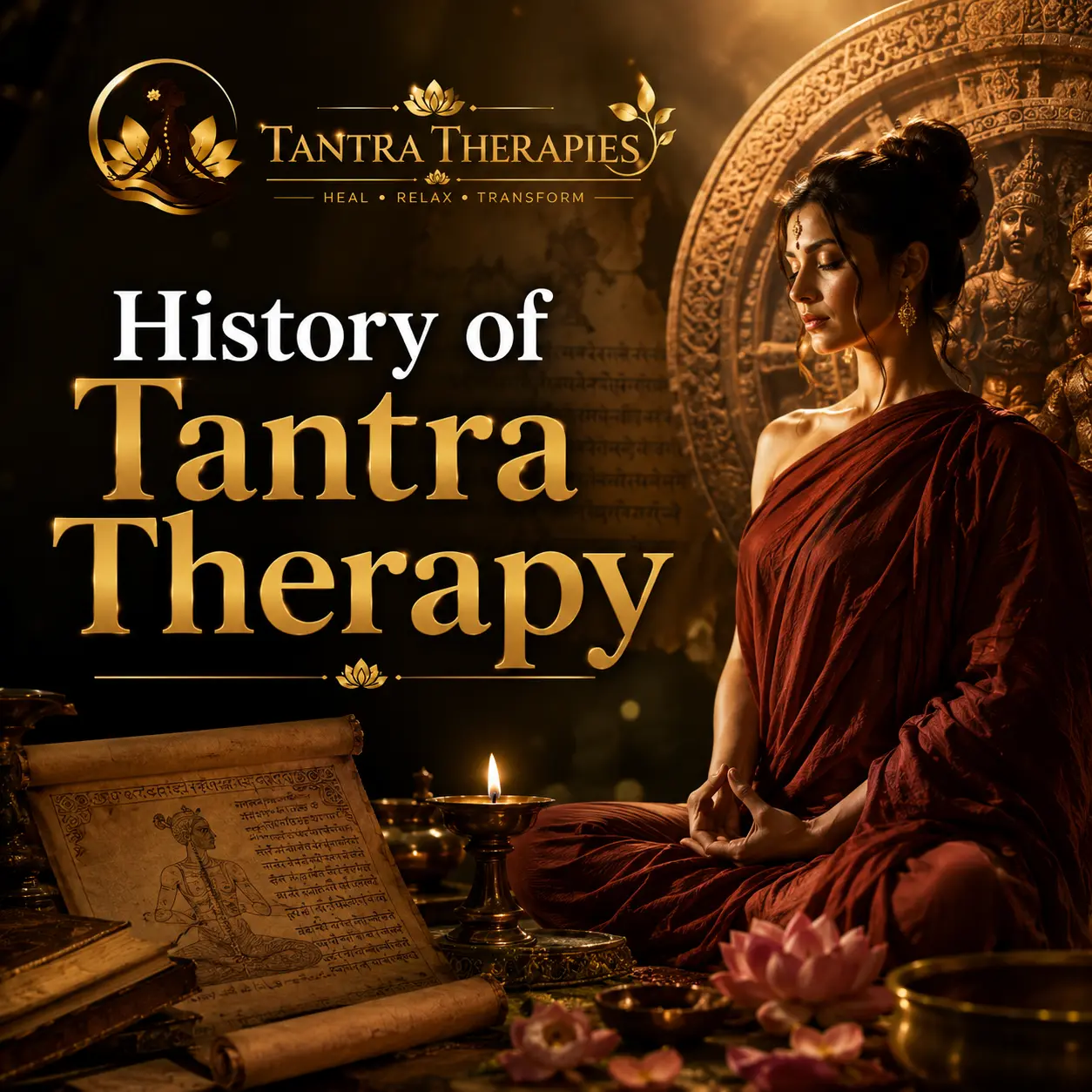
The earliest foundations of Tantric thought date back to pre-Vedic India, with elements tracing to the Indus Valley Civilization. However, the formalization of Tantra occurred between the 5th and 9th centuries CE. During this Golden Age, a vast body of sacred texts known as the Tantras or Agamas were composed across India, Kashmir, and Tibet.
Two primary philosophical branches developed during this era:
- Kashmir Shaivism: A non-dualistic philosophy teaching that everything in existence is a single, divine consciousness (Shiva) experiencing itself through energy (Shakti). There is no separation between the sacred and the mundane.
- Buddhist Tantra (Vajrayana): Flourishing in Tibet and Northern India, this branch integrated rapid transformation techniques, utilizing visualizations, mudras, and mantras to achieve rapid enlightenment.
During this period, complex charts of the subtle energy body—including the system of nadis (energy channels) and chakras (energy vortexes)—were meticulously mapped out. These maps form the exact framework that modern Tantra practitioners use today to help clients clear emotional blockages.
Suppression, Misunderstanding, and the Colonial Era
As history progressed, Tantra faced massive challenges. With the arrival of colonial powers and Victorian-era moralities in India during the 18th and 19th centuries, Tantric practices were heavily suppressed. Colonial rulers and orthodox scholars, unable to comprehend the sophisticated use of bodily energy and non-dual philosophy, mischaracterized Tantra as primitive, dark, or purely hedonistic.
This historical mischaracterization is the direct reason why so many misconceptions about Tantra persist in the mainstream world today. Much of the profound psychological and somatic knowledge developed by ancient masters was hidden underground to preserve its purity and safety.
The 20th Century Western Renaissance and Neo-Tantra
In the mid-to-late 20th century, Eastern philosophies began to cross over to the Western world. Western psychologists, seekers, and somatic pioneers discovered these ancient texts and recognized their immense psychological value. Intellectuals and therapists realized that what Western psychoanalysis was trying to achieve through talk therapy, Tantra had been accomplishing through the body for centuries.
Pioneers of somatic psychology, such as Wilhelm Reich (who theorized "body armor" and muscular tension), mirrored ancient Tantric concepts of energy blockages. Concurrently, the "Neo-Tantra" movement emerged, adapted largely by Western teachers to focus predominantly on relationship enhancement and intimacy. While Neo-Tantra brought awareness to the field, it often left behind the broader spiritual and holistic healing frameworks of the original science.
Modern Tantra Therapy at Tantra Therapies
Today, contemporary Tantra Therapy bridges the gap between ancient Eastern mysticism and modern, trauma-informed Western psychology. At Tantra Therapies, we do not view Tantra as a static historical artifact, but as a living, evolving science. By taking classical techniques of breathwork, energy awareness, and meditation, and combining them with modern insights into nervous system regulation, we provide a sophisticated, safe, and deeply effective therapeutic tool for the modern individual seeking genuine wholeness.